Dominating the AI-Search Era: How Answer Engine Optimization (AEO) Can Transform Your Business in 2025
In a digital landscape where search results are increasingly curated by AI-powered engines and voice assistants, simply ranking on page one of Google isn’t enough anymore. With Answer Engine Optimization (AEO) you position your brand as the authoritative answer—capturing the spotlight of tools like ChatGPT, Gemini and Perplexity before your competitors even appear in blue links. At AEO Growth Agency, we help businesses stop being just found, and instead become chosen.
Answer Engine Optimization: Optimizing for AI Search
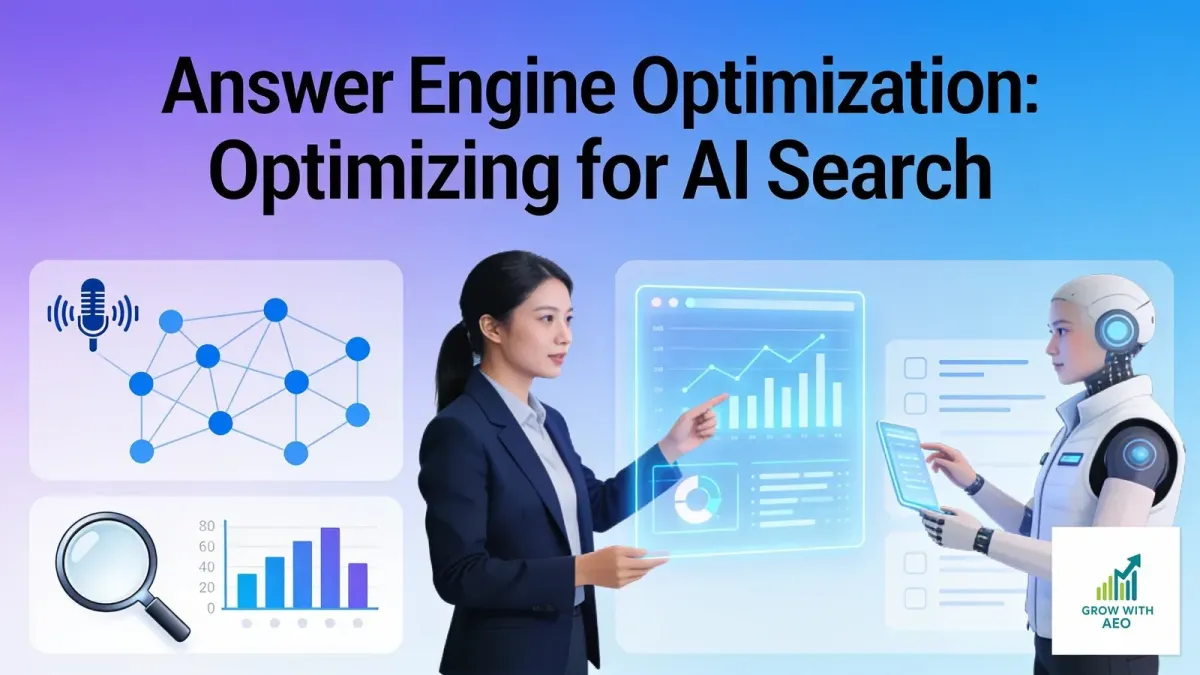
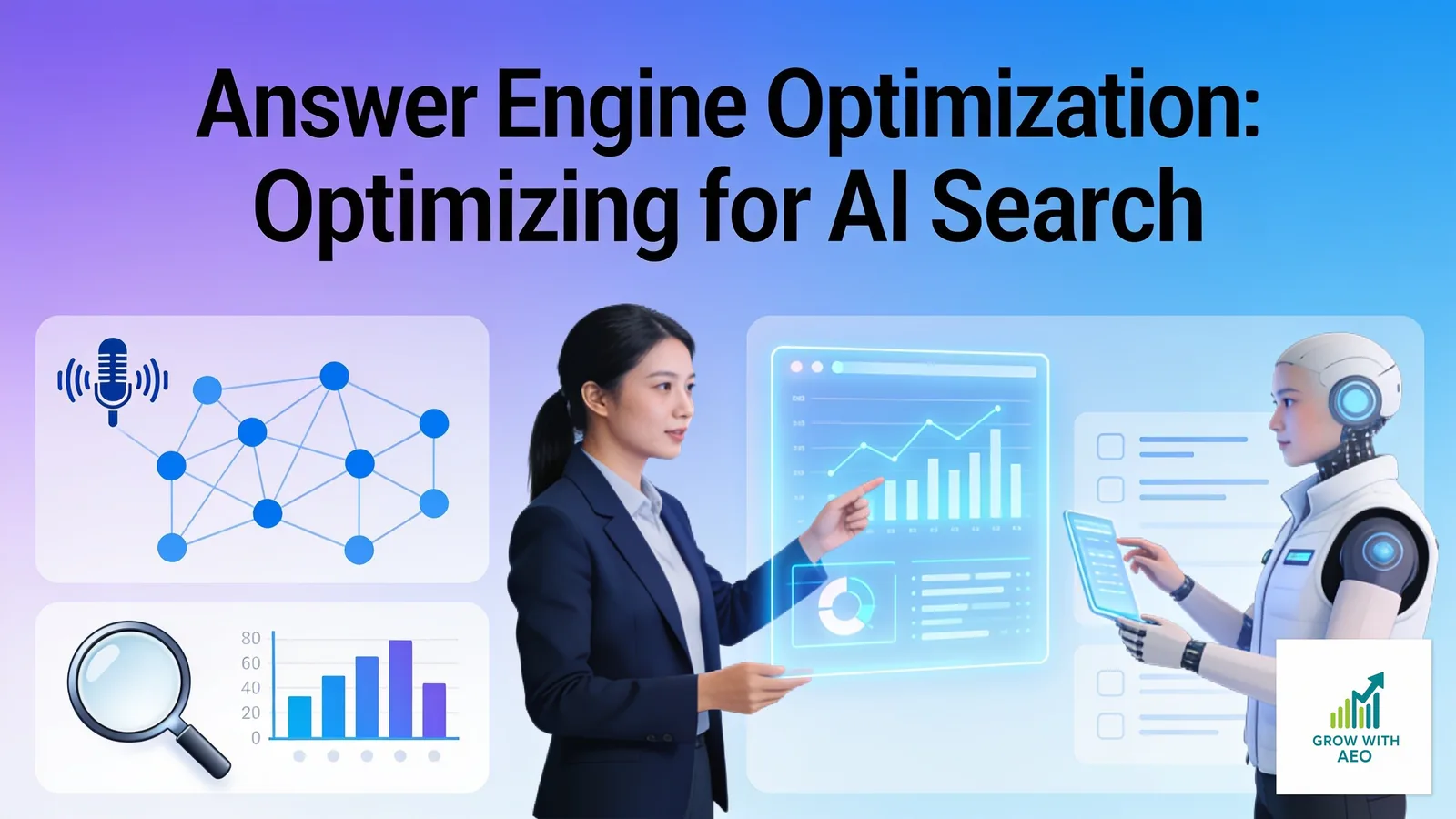
Answer Engine Optimization: Optimizing for AI Search
By Grow with AEO Editorial Team · Updated 2026-07-28
Answer Engine Optimization (AEO) structures content so AI systems like ChatGPT, Gemini, and Perplexity understand, trust, and cite it as direct answers. Optimizing for AI search requires clear entity statements, extractable facts, and structured data instead of link-ranking tactics—Grow with AEO builds this citation-ready foundation for brands seeking AI visibility.
Key Takeaways
- Answer Engine Optimization structures content for AI tools like ChatGPT and Perplexity to cite directly.
- AI-driven website traffic converts 40-300% better than traditional search traffic for businesses.
- The average AI user performs 34 queries daily, creating significant visibility opportunities for brands.
- Website visitors from AI answer engines bounce 40% less than traditional search visitors.
What Will You Learn to Optimize for AI Search?
A structured curriculum answers this question directly: clients learn to shape content so answer engine optimization becomes a repeatable process, not a guessing game. AEO rests on structuring and formatting content so AI tools understand, trust, and cite it as a direct answer to a user's question. That means learning the mechanics behind citation, not just chasing rankings.
The curriculum starts with AI search optimization fundamentals: how large language models parse text, extract facts, and decide what earns a citation. From there, marketing teams practice how to optimize content for AI search using clear headings, direct answers, and factual density that models can elevator cleanly.
What Topics Does an AEO Curriculum Cover?
Coursework typically moves through a defined sequence:
- Understand AEO vs SEO — how ranking for links differs from earning citations.
- Study AI search engines ChatGPT Perplexity and how each surfaces sourced answers differently.
- Apply schema markup for AI search to make entities and facts machine-readable.
- Address zero-click search behavior, where answers appear without a site visit.
- Practice AI Overviews optimization techniques for Google's synthesized results.
Why Does Query Volume Matter for This Training?
Query volume matters because the average AI user runs 34 searches daily, creating dozens of chances to appear — or vanish — in a single day. Every unanswered query is a missed introduction to a potential customer. Grow with AEO built its answer engine optimization guide around this reality, helping businesses get found by high-value customers across AI and voice search rather than relying on traditional link rankings alone.

What Is Answer Engine Optimization, Exactly?
Answer engine optimization, or AEO, improves how often and how accurately a business appears inside AI-generated answers on platforms like ChatGPT, Gemini, and Perplexity. Businesses that skip this discipline lose visibility the moment a competitor's content gets cited instead of theirs, and that lost citation rarely comes back for the same question. Industry analysts now call AEO the fastest-growing discipline in digital marketing, precisely because it determines whether a brand shows up at all across ChatGPT, Gemini, and Microsoft Copilot. Marketing leaders who treat it as optional risk becoming invisible to an entire generation of AI-first searchers.
The shift matters beyond text-based chat interfaces. Voice assistants now play a major role in daily information-seeking, with 41% of adults using voice search every day. Every one of those spoken queries needs a clear, extractable answer sitting somewhere on the web. And AEO exists to make sure that answer belongs to the client's brand, not a competitor's.
How is AEO different from traditional SEO?
AEO vs SEO comes down to what each discipline optimizes for. Traditional SEO chases rankings and click-through rates on a results page; AEO focuses on getting content selected, quoted, and cited directly inside an AI-generated response. The goal shifts from earning a click to earning a citation.
Why does AEO matter for B2B and B2C brands right now?
AEO helps a brand stand out on AI-powered platforms by making its content more likely to be chosen as the answer to a user's question. For marketing leaders managing both B2B and B2C pipelines, that selection process now shapes:
- Which vendor gets named in a buyer's AI-assisted research
- Which product appears in a voice assistant's recommendation
- Which brand earns trust before a human ever visits the website
Grow with AEO builds strategies engineered around exactly this selection mechanism, wherever a client's audience searches.

How Does AEO Differ From Traditional SEO?
Answer engine optimization targets accurate, citable answers rather than ranked links. Traditional SEO chases position on a results page; AEO aims for a direct mention inside an AI-generated response. That distinction reshapes how content gets written, structured, and measured for organizations building visibility across AI search engines like ChatGPT and Perplexity.
AEO vs SEO isn't an either-or choice. Search engine optimization and AEO strategies work together, strengthening site indexing while formatting pages so answer engines can extract clean, quotable passages. Combining both disciplines keeps traffic flowing from classic search results while opening a second channel through AI-generated answers.
| Factor | Traditional SEO | AEO |
|---|---|---|
| Primary goal | Rank links on a results page | Become the cited answer |
| Success metric | Position, click-through rate | Citation frequency, answer accuracy |
| Traffic pattern | High volume, mixed intent | Lower volume, higher conversion |
| Content format | Keyword-optimized pages | Extractable, structured answers |
Why does AI-referred traffic convert better?
Traditional search traffic keeps shrinking, largely because users get answers without clicking through. AI-referred visitors, by contrast, arrive already informed and closer to a decision. Data shows AEO and AI-driven traffic converts 40-300% better than traditional website search traffic, a gap too large for marketing teams to ignore.
Does this mean SEO is obsolete?
No. SEO still builds the technical foundation—crawlability, site structure, backlinks—that answer engines depend on for trust signals. AEO layers on top, focusing that foundation toward direct extraction and citation. Marketing leaders lose ground by treating the two as competitors instead of partners in a single AI search optimization strategy.
How Do You Audit Your Current AI Visibility?
An AI visibility audit starts with a simple test: ask ChatGPT, Perplexity, and Google's AI Overviews the questions a target buyer would ask, then record whether the brand shows up. Buyers already ask AI these questions directly. A brand absent from those answers loses customers to competitors that appear instead. That gap carries real financial weight. Visitors arriving through AI search optimization-driven channels convert at a rate 4.4 times higher than traditional organic search visitors.
Before running the audit, marketers need a list of 15-20 buyer questions, access to at least three AI platforms, and a spreadsheet to log citation results.
- List the core questions prospects type into search or ask a voice assistant.
- Submit each question to AI search engines ChatGPT Perplexity, Gemini, and Copilot.
- Record whether the brand appears, gets cited by name, or is ignored entirely.
- Note which competitor sources the engines cite instead.
- Check existing pages for schema markup for AI search and structured data gaps.
- Compare findings against AEO vs SEO performance metrics already tracked in analytics.
What Should a Marketer Look for During the Audit?
Marketers should look for direct citations, paraphrased mentions, and complete omissions across each platform. Patterns matter more than a single result — a brand missing consistently across five or more queries signals a structural content gap, not bad luck.
Should a Marketer Handle the Audit Alone or Bring in a Specialist?
A do-it-yourself audit uncovers surface-level gaps, but pairing that work with a certified AEO specialist strengthens both the diagnosis and the resulting strategy. Working alongside a Qualified.org-certified AEO specialist adds a layer of technical rigor that catches structural issues a generalist marketer might miss.
| Audit Approach | Strength | Limitation |
|---|---|---|
| Self-run audit | Fast, low-cost, immediate | Misses technical schema issues |
| Specialist-led audit | Certified expertise, deeper diagnosis | Requires outside engagement |
How Do You Structure Content for AI Search Engines?
Structuring content for AI search engines starts with direct answers, not clever introductions. Marketing teams building an answer engine optimization guide for their organization should treat the first sentence of any page as the sentence a chatbot will actually quote. As search behavior shifts from scrolling link lists to reading synthesized answers, brands that fail to format for extraction lose visibility to competitors who do.
Follow this sequence when rebuilding a content structure for AI-first discovery:
- State the direct answer to the target question in the opening sentence, before any context or backstory.
- Format the surrounding paragraph as a self-contained snippet, since AI search engines ChatGPT Perplexity and similar tools pull isolated chunks rather than full articles.
- Add a clear question-based subheading above each major answer, matching the phrasing real customers use.
- Apply schema markup for AI search so crawlers can confirm entity relationships between the brand and the topic.
- Test the page against a follow-up question to confirm the answer still holds without the missing context.
Why does question-based formatting matter for AI visibility?
Content organized around direct questions gets selected more often as the response an assistant reads aloud or displays. Pages written as narratives, with the answer buried in paragraph four, rarely get chosen at all.
Does structure actually affect engagement, not just citation?
Yes. Visitors arriving through AI answer engines show a 40% lower bounce rate than those coming from traditional search results. That gap rewards optimize content for AI search efforts specifically. Well-structured pages satisfy the visitor immediately instead of forcing a hunt for the answer. Strong structure, in short, does double duty: it earns the citation and keeps the visitor once they arrive.
How Do You Apply Schema Markup for AI Search?
Structured data tells AI search engines like ChatGPT, Perplexity, and Google's AI Overviews exactly what a page contains. Schema markup for AI search turns loose paragraphs into labeled facts—names, prices, steps, ratings—that algorithms parse without guessing. Skipping this step forces AI systems to interpret unstructured text, and misinterpretation costs brands citations entirely.
Marketing teams pursuing AI search optimization should follow a set sequence rather than bolting on random tags. Before starting, teams need a content audit that flags pages already ranking for informational queries. Those pages benefit most from added structure.
- Identify page types eligible for structured data: FAQ, HowTo, Article, Product, and Organization schemas cover most B2B and B2C content.
- Add JSON-LD code to each page's HTML head, matching schema.org vocabulary precisely.
- Validate markup using a schema testing tool before publishing.
- Monitor which marked-up pages appear in AI-generated snippets over the following weeks.
Does Schema Markup Guarantee an AI Citation?
No single tag guarantees a citation. Structured data improves extractability. AEO functions as the broader discipline of engineering how content gets understood and cited across AI systems. Schema markup is one lever inside that larger engineering process, not a standalone fix.
Why Does Structured Data Matter More for AI Than Traditional SEO?
Traditional SEO rewards link authority and rank position. AEO vs SEO comparisons show that answer engines instead prioritize accurate, extractable responses over ranked lists. Clean data formatting gives AI models confidence to quote a source directly, which supports stronger site visibility and credibility in generated answers.
Grow with AEO builds and validates schema architecture for organizations pursuing AI-driven visibility, wherever their audience searches.
How Do You Optimize for AI Overviews and Zero-Click Search?
Optimizing for AI Overviews optimization starts with restructuring content so answer engines can extract a complete response without a click. Search behavior has moved away from scrolling link lists; users now receive synthesized answers pulled directly from AI systems. That shift makes zero-click search a permanent fixture, not a passing trend, and brands that ignore it lose visibility inside the answer itself.
Marketing leaders often assume a missed click means a missed opportunity. The data says otherwise. AEO-driven traffic converts 40% to 300% better than traditional search traffic. Visitors arriving through AI answer engines show a 40% lower bounce rate than those from standard search results. Ranking inside the answer, even without a click, still delivers measurable business value.
What does it take to actually rank inside an AI Overview?
Content needs a clear, extractable answer near the top, paired with structured formatting an engine can parse quickly. Marketing teams should treat each page as a standalone answer, not a chapter in a longer narrative.
Before starting, teams need existing content audited for clarity, structure, and factual accuracy — messy pages rarely get cited. From there, the process follows a repeatable sequence:
- Identify the exact question each page should answer, based on real buyer queries.
- Write a direct, 40-to-55-word answer at the top of the page.
- Apply schema markup for AI search so engines can confirm entities and context.
- Break supporting details into scannable lists and short paragraphs.
- Monitor citation performance across AI search engines ChatGPT Perplexity and refine underperforming pages monthly.
This sequence turns AI search optimization into an ongoing discipline rather than a one-time fix, aligning content with how modern answer engines actually select and cite sources.
What Mistakes Undermine Your AEO Efforts?
Three errors quietly sabotage most brands attempting answer engine optimization: chasing outdated traffic metrics, staying invisible in AI-generated answers, and ignoring how people actually speak to their devices. Each mistake compounds the others, and together they push a business further from the results competitors are already capturing through smart AI search optimization.
Why does ignoring AI-referred traffic hurt a business?
Traditional search traffic continues to decline. Traffic referred by AI assistants converts at a higher rate because those visitors arrive with clearer intent. Teams that keep optimizing purely for legacy rankings miss this shift entirely. They measure success against a shrinking pool of clicks instead of the growing, more qualified audience arriving through AI search engines like ChatGPT and Perplexity.
What happens when a brand never gets mentioned in AI answers?
Buyers now ask AI tools directly before ever visiting a company website. When a brand's name never surfaces in those conversational answers, prospects simply choose whichever competitor does appear. That loss happens silently — no bounce rate, no abandoned cart, just a customer who never knew the brand existed.
A third overlooked gap involves voice interfaces. Roughly 41% of adults use voice search daily, yet many content strategies still target only typed queries. Skipping this channel means missing nearly half the adult population on a regular basis.
Common gaps to correct include:
- Auditing current visibility — Check whether the brand's name, offerings, and unique claims appear in responses generated by major AI engines.
- Restructuring content for extraction — Rewrite key pages so answers sit in clear, quotable sentences near the top.
- Adding structured data — Apply schema markup for AI search so bots can parse entities, services, and locations accurately.
- Optimizing for spoken queries — Adjust phrasing to match how people talk, not just how they type.
Grow with AEO, founded by Sean Hyde, a Qualified.org Certified AEO Specialist, helps organizations close these exact gaps. The agency identifies where a brand disappears from AI answers. Rebuilds content so it gets found by the customers who matter most. No matter where those customers search from.
FAQ
What is answer engine optimization?
Answer Engine Optimization structures content so AI systems like ChatGPT, Gemini, and Perplexity understand, trust, and cite it as a direct answer. It improves how often and accurately a business appears inside AI-generated answers instead of traditional search rankings.
How does AEO differ from traditional SEO?
AEO focuses on earning citations through clear entity statements, extractable facts, and structured data. Traditional SEO relies on link-ranking tactics. AEO curricula teach marketers to distinguish ranking for links from earning direct citations in AI answers.
Why does AEO matter for business traffic and conversions?
AI-driven traffic converts 40-300% better than traditional search traffic, and visitors from AI answer engines bounce 40% less. With 34 daily queries per average AI user, brands gain frequent chances to reach high-value customers.

Don't Get Left Behind
What happens if you ignore this shift in marketing? You'll continue to fight for scraps in an overcrowded SEO landscape. You'll miss out on the highest-quality customers. And you'll watch as your competitors who embrace AEO leave you behind.
Ready to Grow Your Business with AEO?
Stop competing and start answering. Get your free AEO Action Plan today and discover how we can help you attract more high-value customers.
Stop competing and start answering. Get your free AEO Action Plan today and discover how we can help you attract more high-value customers.