Dominating the AI-Search Era: How Answer Engine Optimization (AEO) Can Transform Your Business in 2025
In a digital landscape where search results are increasingly curated by AI-powered engines and voice assistants, simply ranking on page one of Google isn’t enough anymore. With Answer Engine Optimization (AEO) you position your brand as the authoritative answer—capturing the spotlight of tools like ChatGPT, Gemini and Perplexity before your competitors even appear in blue links. At AEO Growth Agency, we help businesses stop being just found, and instead become chosen.
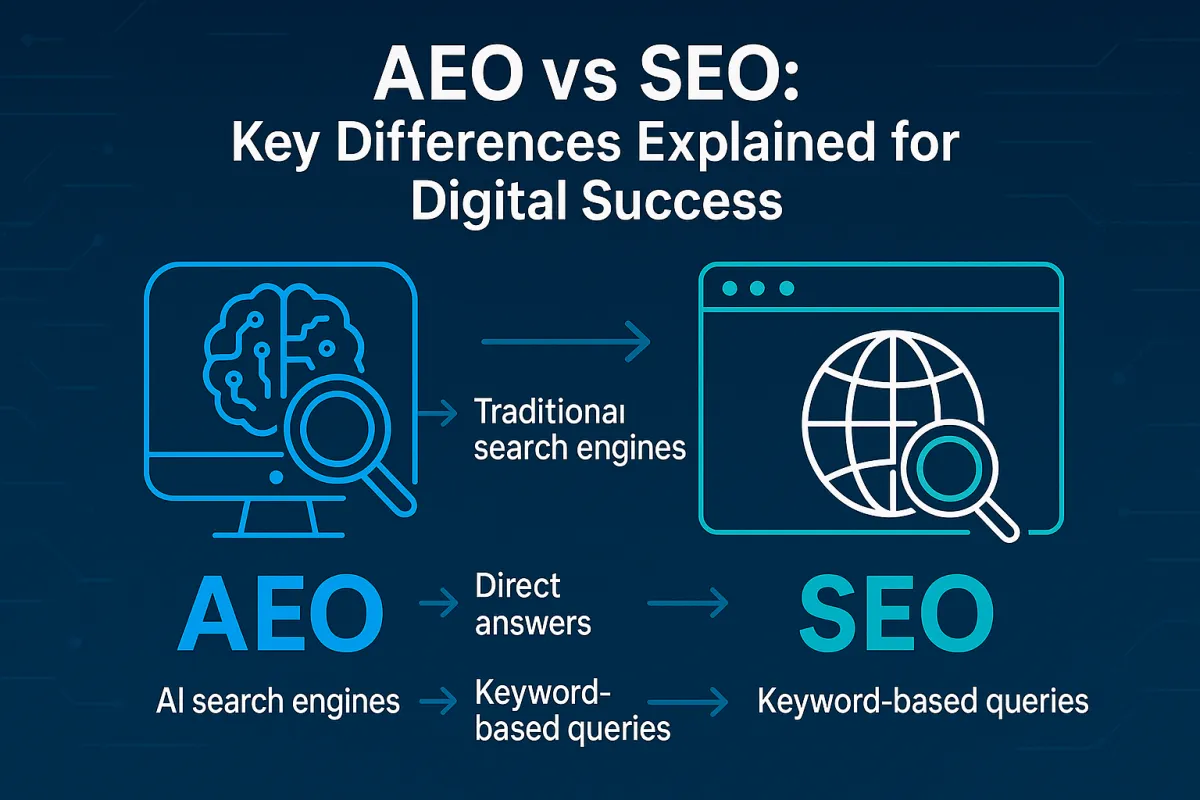
AEO vs SEO: Key Differences Explained for Digital Success
How Does AEO Compare to SEO: Key Differences and Business Benefits Explained
Search and discovery have evolved, fundamentally reshaping modern **marketing strategy**. Answer Engine Optimization (AEO) focuses on crafting concise, structured responses for AI-driven and conversational platforms, while Search Engine Optimization (SEO) targets traditional ranking signals that drive **organic search results** to web pages on platforms like Google and **Microsoft Bing**. This article, authored by **Sean Hyde**, a leading expert in digital marketing and **search optimization** strategies, explains both models, the mechanisms behind each approach, and why comparing AEO vs SEO matters for business visibility and lead generation. Readers will learn how SEO components like technical optimization and backlinks interact with AEO tactics such as schema markup and concise answer blocks, how Generative Engine Optimization (GEO) extends both strategies for LLMs, and a practical integration roadmap you can apply. The piece balances strategic explanations with operational steps, lists, and EAV-style tables to make adoption actionable for **content marketing** teams and decision-makers. Throughout, we use semantic best practices—entity clarity, schema-focused tactics, and measurable KPIs—to show how companies can maximize online visibility and **brand awareness** across search engines and AI answer platforms.
What Is Search Engine Optimization and How Does It Work?
Search Engine Optimization (SEO) is the practice of improving a website’s visibility in traditional **search engine results pages** (SERPs) by aligning content, technical signals, and authority signals with user intent. SEO works through a basic flow—crawl, index, rank—where crawlers discover pages, indexable content is stored, and ranking algorithms order results by relevance and authority; the result is increased **organic traffic** and qualified leads. The mechanism combines on-page relevance, site technical health, and off-page authority, which together improve a page’s ability to appear for organic queries and featured snippets. Understanding these mechanics sets the stage for distinguishing SEO’s long-term authority-building role from the faster, answer-focused methods used by AEO.
What Are the Core Components of SEO?

SEO’s core components are content relevance, technical infrastructure, backlink authority, and user experience signals, each contributing to ranking and discoverability. Effective **keyword research** and topical relevance guide **content marketing** creation so pages match searcher intent, while technical SEO—crawling, mobile friendliness, site speed, and canonicalization—ensures search engines can access and correctly index content. Backlinks and citations act as external endorsements that raise domain authority and **credibility**, and UX signals like click-through rate, dwell time, and low bounce support ranking resilience. These components together create a durable foundation for organic visibility; the next subsection explains how those elements translate into measurable traffic and ranking gains.
How Does SEO Drive Organic Traffic and Improve Rankings?
SEO drives organic traffic by aligning content with searcher intent and ensuring technical accessibility so algorithms can evaluate and surface pages to relevant queries. The crawl → index → rank process depends on signals: relevance of on-page content, structured data, authority inferred from backlinks, and behavioral signals that indicate user satisfaction. Measurement relies on tools like search console analytics and web analytics to track impressions, clicks, average position, and conversion paths—metrics that indicate how ranking changes translate into business outcomes. Translating ranking improvements into conversions closes the loop between visibility and revenue, which motivates a strategy that blends content depth with technical optimization.
Why Is Traditional SEO Important for Business Growth?
Traditional SEO builds sustained, compound growth by generating predictable **organic traffic** that reduces paid acquisition costs over time and strengthens **brand authority** and **credibility** in **search engine results pages**. Long-form content, pillar pages, and topical clusters create evergreen assets that attract links, social signals, and recurring visits, which compound into higher lifetime value per visitor. SEO also supports downstream conversion strategies—lead capture, retargeting, and content-driven funnels—that increase return on investment compared with short-term ad buys. With that foundation in place, businesses can layer AEO tactics to capture immediate answer-driven queries without abandoning the long-term benefits of SEO.
What Is Answer Engine Optimization and Why Is It Emerging?
Answer Engine Optimization (AEO) is the practice of structuring content and metadata so AI-driven systems and conversational platforms can extract and present concise answers directly to users. AEO emerged because large language models (LLMs), AI overviews, and voice assistants increasingly prefer short, authoritative answer blocks and rely on structured signals—schema, FAQs, HowTo elements—to surface direct responses. This evolution in **search optimization** reflects a shift in user behavior. The mechanism favors entity clarity and succinct, well-sourced answers that are easy for models to cite and for voice interfaces to read, delivering fast visibility in zero-click contexts. Grasping AEO’s emphasis on brevity and structured markup clarifies why businesses must optimize both long-form pages and short-form answer assets.
What Are the Key Elements of AEO?
AEO relies on schema markup, concise answer blocks, FAQ and Q&A structures, and explicit entity signals to increase the chance of being selected as an authoritative answer. Schema types such as FAQ, QAPage, HowTo, and Speakable help machines identify answerable content, while short paragraphs and list formats provide LLMs clear, extractable snippets. Entity clarity—consistent naming, canonical sources, and internal linking—helps AI attribute facts to your domain, and citation signals like references and authoritativeness boost trust and **credibility**. These elements form a practical checklist marketers can implement with minimal technical overhead, described next in tactical terms for AI-powered consumption.
AEO implementation checklist contains practical, prioritized tasks: Add FAQ and HowTo schema: Mark clear Q&A content to signal answer candidates. Create concise answer blocks: Limit direct answers to one-to-three sentences with supporting context. Canonicalize entities: Use consistent naming and structured data to distinguish brand and product entities.
A short summary: These steps increase the chance that AI systems and voice assistants will surface your content as a direct answer, which often leads to faster visibility than waiting for longer-term organic ranking improvements.
How Does AEO Optimize for AI-Powered Search and Direct Answers?
AEO optimizes for AI by formatting content so LLMs and answer engines can extract precise facts and attribute them to a reliable source, which increases citation likelihood in generated responses. Tactics include using clear headers, bullet lists, short definitional paragraphs, and schema to expose semantic triples—entity → relationship → attribute—for downstream models to ingest. Citation and trust signals (authoritative sources, high-quality references, transparent attribution) increase the probability an AI will use your content, and pairing concise answers with contextual links preserves pathways to deeper content. Structuring content for extractability resolves the practical challenge of being chosen as a single-source answer among many possible references.
The escalating prevalence of Answer Engine Optimization (AEO) is profoundly reshaping the digital marketing paradigm, necessitating a revised content strategy that extends beyond conventional Search Engine Optimization (SEO).
The Ascendancy of Answer Engine Optimization (AEO) and Its Ramifications for SEO
The escalating prevalence of Answer Engine Optimization (AEO), characterized by AI-driven search engines increasingly furnishing direct responses to user inquiries, is profoundly reshaping the digital marketing paradigm. This transition mandates a revised content strategy, extending beyond conventional Search Engine Optimization (SEO) to incorporate AEO methodologies such as structured data and entity optimization. As artificial intelligence models attain greater sophistication, comprehending and deploying AEO will be paramount for enterprises seeking to preserve their visibility and pertinence within search engine rankings.
The Impact of AI-Powered Search on SEO: The Emergence of Answer Engine Optimization
What Are the Unique Benefits of AEO for Businesses?

AEO delivers faster visibility for targeted queries, stronger presence in voice and conversational channels, and a distinct slot in AI-generated overviews that can drive direct actions such as calls or conversions, significantly boosting **brand awareness**. Because AEO targets specific queries with concise answers, time-to-visibility is often measured in weeks rather than months, and local or branded queries can lead to immediate engagement improvements. AEO can increase trust and click-through for voice interactions and zero-click answers by positioning the brand as the authoritative source for short, actionable information.
The table below maps specific AEO benefits to measurable business impacts so teams can prioritize implementation.
AEO CapabilityBenefitBusiness Impact (KPI)Direct Answers (FAQ/HowTo)Higher answer visibility in AI responsesIncreased voice/AI-driven conversionsSchema MarkupClear machine-readable structureHigher citation and featured answer rateConcise Answer BlocksFaster extraction by LLMsReduced time-to-visibility (weeks)Entity CanonicalizationImproved trust and attributionBetter brand presence in AI overviews
This table shows how AEO tactics translate directly into KPIs companies can track, guiding prioritization when resources are limited and encouraging measurable experiments.
What Are the Main Differences Between AEO and SEO?
AEO and SEO differ in goals, timescales, content formats, and technical priorities: AEO seeks concise, machine-extractable answers for AI and voice, while SEO focuses on comprehensive content that ranks across a broad set of queries. The methods diverge—AEO emphasizes schema, entity clarity, and short answer blocks; SEO emphasizes topical depth, backlinks, and technical site health—yet both overlap where structured, authoritative content helps both machine and human users. Metrics differ too: AEO success looks like featured answers, citation rate, and AI visibility measures, while SEO success is measured by organic impressions, positions, and traffic-driven conversions. Understanding these contrasts helps teams allocate effort where they’ll see the most immediate and long-term return.
Below is a systematic comparison to highlight core distinctions and operational priorities.
StrategyPrimary AttributeTypical OutcomeAEODirect-answer formatting, schema, entity clarityFaster citation in AI/voice; quick visibilitySEOTopical depth, backlinks, technical SEOSustained organic traffic growth; authorityGEO overlapLLM-friendly structure and citation signalsIncreased chance of being included in generative overviews
These contrasts demonstrate how each approach serves distinct stages of the discovery funnel while sharing a mutual reliance on trust and structured content.
How Do AEO and SEO Differ in Goals and Methods?
AEO’s goal is to provide the single best answer for a specific query so AI and voice interfaces can present it directly, whereas SEO’s goal is broader: to rank pages across many queries and attract sustained organic traffic. Methods differ accordingly—AEO prescribes short, factual snippets, FAQ schema, and explicit entity markers, while SEO prescribes content clusters, link building, and technical improvements to enable discovery and indexing. KPIs mirror these differences: AEO tracks answer capture rates and AI citations; SEO tracks impressions, positions, and backlink growth. Knowing which objective suits a campaign clarifies resource allocation between immediate answer capture and long-term authority building.
What Content Formats Suit AEO vs. SEO?
AEO performs best with concise formats—FAQs, short definitions, bullet lists, and step-by-step snippets that machines can extract easily; SEO benefits from long-form guides, pillar pages, comprehensive tutorials, and rich media that attract backlinks and dwell time. Hybrid formats such as a long-form article with dedicated FAQ blocks and schema-marked answer snippets can serve both aims, enabling pages to rank organically while also offering extractable answers for AI. A practical decision guide: create short, schema-marked answer blocks for high-intent, narrow queries, and develop in-depth cornerstone content for broader informational needs. This combined approach preserves depth while enabling immediate answer opportunities.
How Do User Behaviors Impact AEO and SEO Strategies?
Increasing conversational queries, voice searches, and zero-click results mean search behavior favors direct answers for quick tasks, while research-driven users still seek long-form resources, creating parallel opportunities for AEO and SEO. Zero-click trends reduce measured clicks but can increase brand impressions and downstream conversions if answer content guides users to take action offline or through alternate channels. Intent mapping—determining which queries seek a direct answer versus a longer exploration—drives content format choices and distribution priorities. Recognizing these behavior patterns helps teams design content that captures discovery in AI channels and nurtures deeper engagement through SEO-driven pages.
Advancements in artificial intelligence and semantic technologies are enabling search engines to better address complex queries by identifying entities and their relationships, though unstructured data on web pages presents a challenge.
AI and Semantic Technologies in Search: Enhancing Query Results Through Entity Recognition
With advancements in artificial intelligence and semantic technologies, search engines are increasingly incorporating semantics to address complex search queries and improve result relevance. This necessitates the identification of well-known concepts or entities and their relationships within web page content. However, the proliferation of complex unstructured data on web pages has rendered concept identification an overly intricate task. Existing research primarily focuses on entity recognition from the perspective of linguistic structures like complete sentences and paragraphs, overlooking the substantial volume of data on web pages that exists as unstructured text fragments within HTML tags. Ontologies offer schemas for structuring web data. Nevertheless, their integration into web pages demands additional resources and expertise from organizations or webmasters, posing a significant impediment to widespread adoption. We propose an approach for the autonomous identification of entities from short text segments found on web pages.
Autonomous schema markups based on intelligent computing for search engine optimization, BUD Abbasi, 2022
How Can Businesses Benefit from Integrating AEO and SEO?
Integrating AEO and SEO creates a complementary **marketing strategy** where AI-driven discovery feeds users into long-form content that converts, and authoritative long-form pages supply the contextual depth that AI systems cite for trust. The combined framework begins with an audit of content and entities, followed by prioritized schema and answer block implementations, and concludes with measurement that tracks both AI visibility and organic conversions. Integration emphasizes mapping content to intent, implementing structured data for extractability, and preserving deep resources behind concise answers to capture and convert traffic across channels. A clear framework helps businesses focus limited resources on high-impact pages that serve both immediate answer queries and long-term search authority.
What Is the Strategic Framework for Combining AEO and SEO?
A practical, step-by-step roadmap helps teams operationalize AEO+SEO: audit, prioritize, implement, measure, iterate—each phase aligning with specific tasks and tools. The audit identifies top queries through thorough **keyword research**, existing content that can be converted into answer blocks, and technical gaps in schema and canonicalization; prioritization ranks actions by potential AI visibility and organic traffic lift. Implementation pairs concise answer assets with robust long-form content and applies schema across prioritized pages, while measurement tracks AI citation rates, featured snippet capture, and organic conversions, providing valuable **insights**. Executing this roadmap creates a structured experiment cycle that both proves the value of AEO tactics and strengthens SEO foundations for sustained growth.
Audit top queries and content: Identify where short answers and long-form assets overlap.
Prioritize high-impact pages: Focus on high-intent queries with conversion potential.
Implement schema and answer blocks: Add FAQ/HowTo schema and concise snippets.
Measure and iterate: Track AI visibility, snippet capture, and downstream conversions.
This checklist operationalizes the framework and makes next steps clear for teams ready to combine tactics.
How Does Integration Maximize Online Visibility and Lead Generation?
Integration creates a funnel where AI-driven answers introduce users to a brand, boosting initial **brand awareness**, and SEO assets provide the depth that converts casual discovery into measurable leads. AEO acts as a top-of-funnel discovery channel—presenting concise, trustworthy answers—while SEO-driven pages capture interest for deeper engagement, email capture, or demo requests. Suggested KPIs include AI Visibility Score, featured snippet capture rate, organic traffic growth, and conversion rate from AI-driven sessions, which together measure both discovery and business impact. Tracking these metrics reveals how combined tactics convert ephemeral AI impressions into durable customer relationships.
What Are Real-World Examples of Successful AEO and SEO Integration?
Local services: Implementing FAQ schema and concise local answers increased voice-query conversions.
E-commerce: Adding extractable product summaries and structured specs led to more AI citations and traffic.
B2B SaaS: Optimizing knowledge base answers and linking to demo pages improved trial sign-ups.
A short service-bridge: For businesses seeking a tailored roadmap that combines these tactics into an operational plan, Grow With AEO offers consultative assessments to map existing content to AEO and SEO priorities and produce a prioritized implementation plan that aligns with lead-generation goals. This introduction transitions into the dedicated service section describing how Grow With AEO approaches combined strategies.
What Is Generative Engine Optimization and How Does It Relate to AEO and SEO?
Generative Engine Optimization (GEO) focuses on preparing content specifically for LLM-driven generative outputs, emphasizing canonical sources, clear citations, and LLM-friendly structure to increase the chance of being included in AI overviews. While SEO aims for broad **search engine results page** rankings and AEO targets direct answers, GEO specifically optimizes for the synthesis capabilities of LLMs. This distinction highlights the evolving landscape of **search optimization**, where **GEO vs SEO** represents a new frontier. GEO overlaps with AEO in its emphasis on extractable facts and with SEO in its need for authoritative, well-structured content; together, these approaches ensure content is both discoverable and trustworthy, enhancing **credibility**. The practical role of GEO is to make content indexable not only by crawlers but also readily usable by generative models like those powering Google SGE and **Perplexity AI** that synthesize multiple sources into an answer. Preparing for GEO means aligning canonical content, implementing robust schema, and maintaining freshness to meet LLM preferences for up-to-date, well-sourced information.
The GEO mapping table below links major generative entities to optimization tactics businesses can implement.
Generative EntityAttributeOptimization TacticGoogle SGEAI overview inclusionUse authoritative summaries, strong schema, and canonical citationsLLMs (Chat-based)ExtractabilityProvide concise answer blocks and explicit entity statementsPerplexity AI & similarSource trustMaintain up-to-date canonical pages and clear references
This mapping clarifies how GEO-specific tactics align with both AEO and SEO priorities to improve citation likelihood in generative outputs.
What Role Does GEO Play in AI Search and Content Visibility?
GEO acts as the bridge between source content and the way generative systems construct multi-source answers, so its role is to make content usable at the atomic fact level while preserving attribution and context. Key signals include freshness, canonical authority, structured markup, and clear metadata that indicate the page is a reliable reference. GEO is particularly important when LLMs synthesize content from multiple domains—if your content is better structured and more authoritative, it has a higher chance of being included and cited. Understanding GEO helps marketing teams prioritize which pages to canonicalize and which data to expose via APIs or structured feeds.
How Should Businesses Prepare Content for Generative AI Platforms?
Preparing content for generative platforms requires a prioritized checklist for your **content marketing** efforts: make answers extractable, implement schema, preserve canonical pages, and ensure data freshness and citation clarity. Structure headers and lists so LLMs can isolate entity relationships, expose machine-readable feeds where appropriate, and include explicit citation lines that indicate provenance and authoritativeness. Monitoring involves tracking AI citation mentions and evaluating whether generative referrals drive meaningful downstream engagement. These steps create a GEO-ready content architecture that supports both immediate AI visibility and long-term organic recognition.
GEO readiness checklist: Expose concise answer snippets inside pages: One-to-three sentence definitions or steps. Implement authoritative schema and metadata: FAQ, HowTo, Article schema where appropriate. Maintain canonical, fresh content: Regular updates signal recency to generative engines.
A final note: GEO preparation complements AEO and SEO by ensuring your content is both extractable for immediate AI responses and deep enough to earn organic authority.
What Are Common Questions About AEO vs SEO?
This section provides concise, snippet-optimized answers to common PAA-style questions, designed to be directly useful for searchers and to increase the chance of featured snippet capture. Each response is focused, authoritative, and framed to show how AEO and SEO interact rather than compete, supporting the practical decisions teams must make when allocating resources to their overall **marketing strategy** and **search optimization** efforts.
Is Traditional SEO Becoming Obsolete with the Rise of AEO?
No—traditional SEO is not becoming obsolete; rather, AEO expands the channels through which content is discovered and requires complementary tactics that often build on SEO foundations. SEO remains essential for sustained **organic traffic**, backlink-based authority, and comprehensive content that supports complex buyer journeys, while AEO captures immediate, intent-driven answer queries that feed discovery. The pragmatic approach to **search optimization** is integration: use SEO to build durable topical authority and AEO to surface concise answers that funnel users into deeper SEO assets. This balanced strategy ensures resilience across both traditional **search engine results pages** and AI-driven discovery.
How Quickly Can Businesses See Results from AEO Compared to SEO?
AEO can produce measurable visibility in weeks for targeted queries, especially when schema and concise answer blocks are applied to high-intent pages; SEO typically takes months to build comparable organic traction for broader topics. Time-to-results depends on existing authority, query competitiveness, and technical readiness—strong domains may see both AEO and SEO gains faster. Businesses should run short AEO experiments on prioritized pages for quicker wins while investing in SEO for long-term scale. Combining both approaches lets teams capture early opportunity while building evergreen assets.
Does AEO Require Special Technical Setup?
AEO requires technical elements commonly used in modern SEO, primarily schema markup and content structure, but it does not demand exotic infrastructure—most CMS platforms and tag managers support FAQ and HowTo schema implementation. Key technical tasks include implementing structured data, ensuring clear canonicalization, and exposing concise answer blocks that are crawlable and machine-readable. Monitoring tools should include AI visibility metrics in addition to search console data to capture answer capture rates. Integrating these technical tasks with existing SEO workflows minimizes overhead while maximizing AI-driven opportunities.
Can Small Businesses Benefit More from AEO Than SEO?
Small businesses can often realize faster visibility gains from AEO for local and narrowly defined queries because concise, schema-backed answers are easier to optimize than competing for broad organic rankings against large domains. For resource-constrained teams, prioritizing AEO on high-intent local and branded queries can deliver measurable calls, bookings, or foot traffic quickly. However, SEO remains important for long-term growth; the best posture is to use AEO for immediate discovery and SEO to retain and expand authority. This dual approach allows small businesses to capture short-term demand without sacrificing future reach.
How Do AEO and SEO Complement Each Other in Digital Marketing?
AEO enhances discovery by surfacing direct answers and driving awareness, while SEO captures and nurtures users for deeper engagement and conversion, creating a funnel that spans initial contact to final action within a comprehensive **marketing strategy**. Shared tactics—structured content, entity clarity, internal linking—benefit both, and hybrid formats like long-form pages with embedded FAQ schema serve both machine and human readers. Coordinated measurement across AI visibility, featured snippet capture, organic traffic, and conversion rates reveals how the combined investment affects business outcomes. This complementary view encourages integrated planning and cross-team collaboration.
The substantial increase in the adoption of devices featuring conversational agents necessitates an investigation into their implications on user search behavior and experience.
The Evolution of Search: Conversational Agents and User Experience
Conversational search has recently emerged as a novel paradigm for information retrieval. A growing number of individuals are utilizing smart speakers and virtual personal assistants to access information online. Considering the substantial increase in the adoption of devices featuring conversational agents, it is opportune to investigate their implications on user search behavior. This thesis examines how conversational search agents influence the user search experience and outcomes for goal-oriented tasks. Our inquiry is motivated by the premise that a fully conversational agent with memory capabilities could yield a superior user search experience compared to an agent based on the slot-filling paradigm, which represents the current state of the art.
Exploring the impact of conversational strategies on user search experience in goal-oriented tasks in a voice-only domain, M Dubiel, 2021
How Does Grow With AEO Support Businesses in Navigating AEO and SEO?
Grow With AEO is a lead-generation and information hub focused on helping businesses improve online presence and AI search visibility by combining SEO and AEO strategically. The company’s approach centers on diagnosing where answer opportunities exist, prioritizing pages that can deliver both rapid AEO wins and long-term SEO value, and delivering a practical roadmap for holistic **search optimization** that teams can implement or contract. Grow With AEO emphasizes measurable outcomes—AI visibility, featured snippet capture, and conversion lift—while guiding clients through schema implementation, content mapping, and iterative measurement. The following subsections outline methodology, generalized success narratives, and how to get started with a consultative engagement that focuses on business impact without overselling services.
What Is Grow With AEO’s Approach to Integrating AEO and SEO?
Grow With AEO applies a four-phase methodology: audit, prioritize, implement, and iterate—each phase aligned with tangible tasks and outcome-focused KPIs. The audit phase inventories queries, content, and schema readiness; prioritization ranks opportunities by potential AI visibility and conversion impact; implementation applies answer blocks, schema, and content rewrites; iteration measures AI and organic performance and refines tactics. The methodology emphasizes entity clarity, canonical sources, and cross-channel measurement so teams can see how AI-driven discovery feeds SEO funnels. This consultative approach ensures technical work is driven by measurable business objectives rather than purely technical metrics.
What Client Success Stories Demonstrate the Benefits of Combined Strategies?
Generalized client narratives show consistent patterns: local service providers capturing voice-search calls after adding FAQ schema, e-commerce brands increasing product visibility when short, structured product summaries were added, and SaaS companies funneling AI-driven knowledge queries into demo requests by optimizing knowledge bases for extractability. These narratives emphasize tactics and outcomes—what was done and what improved—without fabricating specifics, illustrating replicable moves other businesses can test. The common lesson is that targeted AEO experiments paired with SEO follow-through produce measurable lift in discovery and downstream conversions.
How Can Businesses Get Started with Grow With AEO’s Services?
Businesses typically begin with an audit request that maps top queries, content gaps, and schema opportunities, followed by a prioritized roadmap that sequences AEO and SEO tasks for maximum short- and long-term impact. The engagement path focuses on quick-win AEO implementations on high-intent pages while scheduling SEO investments to reinforce authority and conversion potential. Grow With AEO’s consultative onboarding emphasizes clear milestones—AI visibility checks, snippet capture metrics, and conversion tracking—so stakeholders can see tangible business value. For teams ready to act, starting with an audit creates a data-driven foundation for combined AEO and SEO optimization.
Frequently Asked Questions
What are the main challenges businesses face when implementing AEO?
Businesses often encounter several challenges when implementing Answer Engine Optimization (AEO). One significant hurdle is the need for a shift in content strategy, as AEO requires concise, structured responses that differ from traditional long-form content. Additionally, understanding and applying schema markup can be complex for teams unfamiliar with technical SEO. There is also the challenge of keeping content updated and relevant to maintain visibility in AI-driven platforms. Finally, measuring the effectiveness of AEO strategies can be difficult, as traditional metrics may not fully capture the nuances of AI interactions.
How can businesses measure the success of their AEO efforts?
Measuring the success of AEO efforts involves tracking specific metrics that reflect visibility and engagement in AI-driven environments. Key performance indicators (KPIs) include the rate of featured snippets captured, the frequency of citations in AI responses, and the overall increase in organic traffic from AI-driven queries. Additionally, businesses should monitor conversion rates from sessions initiated through AI platforms to assess the effectiveness of their AEO strategies. Utilizing tools like Google Search Console and analytics platforms can help in gathering and analyzing this data effectively.
What types of content are best suited for AEO?
Content that is best suited for AEO typically includes concise formats such as FAQs, How-To guides, and short definitions. These formats allow for quick extraction by AI systems and voice assistants. Bullet points, numbered lists, and clear headers also enhance the extractability of information. Additionally, content that addresses specific user queries or provides straightforward answers tends to perform well in AEO contexts. Businesses should focus on creating structured content that aligns with common questions and intents to maximize their chances of being featured in AI responses.
How does AEO impact local SEO strategies?
AEO significantly impacts local SEO strategies by enhancing visibility in voice search and AI-driven local queries. By optimizing for AEO, businesses can provide concise, relevant answers to common local questions, which increases the likelihood of being featured in voice search results. Implementing local schema markup, such as for business hours and locations, can further improve visibility. This approach not only helps in capturing immediate local traffic but also builds brand authority in local search contexts, ultimately driving more foot traffic and inquiries.
Can AEO be integrated with existing SEO strategies?
Yes, AEO can and should be integrated with existing SEO strategies for a comprehensive approach to digital marketing. By combining AEO's focus on concise, structured answers with SEO's emphasis on long-form content and authority building, businesses can create a robust content strategy. This integration allows for the capture of immediate answer-driven queries while also nurturing deeper engagement through traditional SEO practices. Implementing schema markup and optimizing for both AEO and SEO can enhance overall visibility and lead generation across various platforms.
What role does user intent play in AEO and SEO strategies?
User intent is crucial in both AEO and SEO strategies, as it drives the type of content that should be created and optimized. Understanding whether users are seeking quick answers or in-depth information helps businesses tailor their content accordingly. AEO focuses on addressing specific, immediate queries with concise answers, while SEO aims to satisfy broader informational needs. By mapping content to user intent, businesses can ensure they meet the expectations of their audience, improving engagement and conversion rates across both AEO and SEO efforts.

Don't Get Left Behind
What happens if you ignore this shift in marketing? You'll continue to fight for scraps in an overcrowded SEO landscape. You'll miss out on the highest-quality customers. And you'll watch as your competitors who embrace AEO leave you behind.
Ready to Grow Your Business with AEO?
Stop competing and start answering. Get your free AEO Action Plan today and discover how we can help you attract more high-value customers.
Stop competing and start answering. Get your free AEO Action Plan today and discover how we can help you attract more high-value customers.