AEO vs SEO: What’s the Difference for Small Businesses?
AEO vs SEO: Understanding Key Differences and Benefits for Small Businesses
Small businesses must improve online visibility to compete. Knowing the differences between Answer Engine Optimisation (AEO) and search engine optimization (SEO) helps you choose the right tactics to attract and engage customers. This article explains how each approach works, the benefits they offer, and practical steps to combine them. You’ll finish with clear guidance to optimize your online presence.
Research shows digital marketing and SEO consistently drive measurable growth for small and medium-sized enterprises.
SEO & Digital Marketing for SME Growth
The digital revolution has reshaped the marketing landscape, creating new opportunities and challenges for small and medium-sized enterprises (SMEs). This study examines the role of digital transformation in marketing, with a focus on how web analytics and search engine optimization (SEO) affect SME growth. Reviewing 85 peer‑reviewed academic articles, industry reports, and case studies, it synthesizes how SMEs leverage digital tools and data-driven strategies to expand market reach, improve customer engagement, and sustain long-term performance.
Digital transformation in marketing: evaluating the impact of web analytics and SEO on SME growth, AJ Mou, 2022
What Is Answer Engine Optimization and How Does It Differ from SEO?
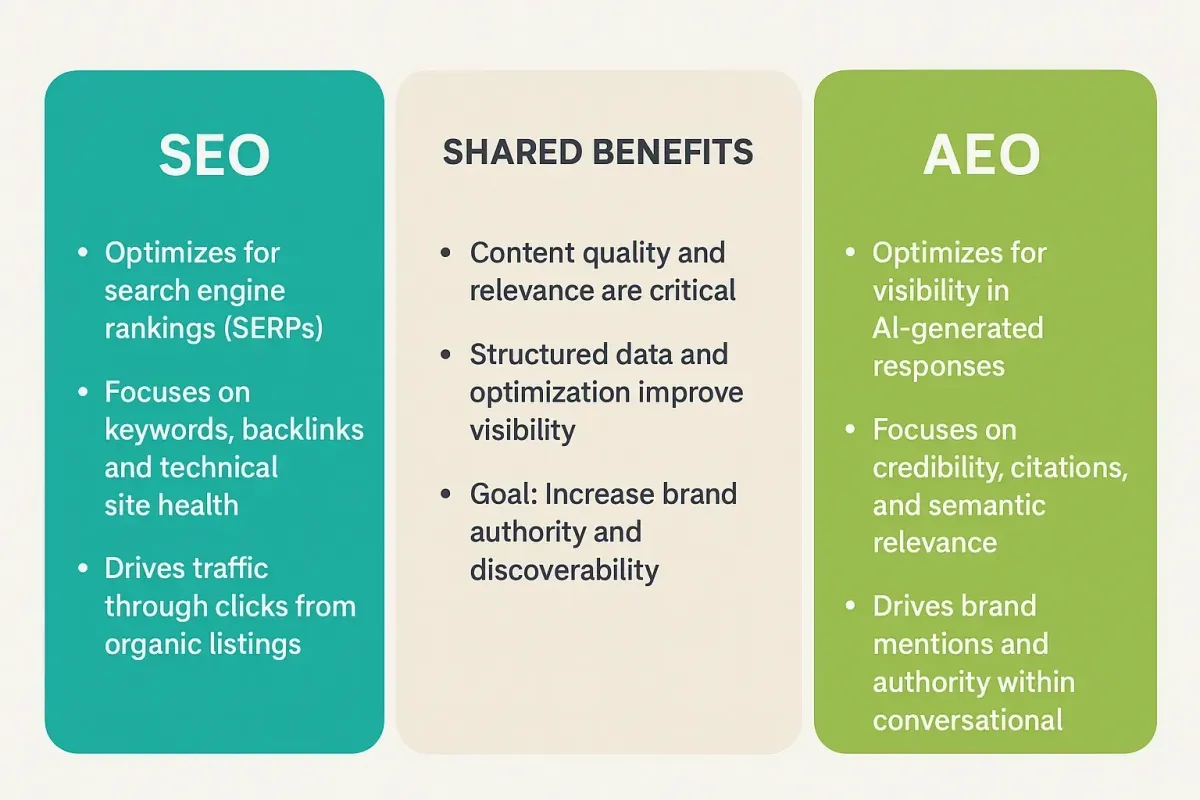
Answer Engine Optimization (AEO) optimizes content so platforms can deliver direct answers to user queries, especially on voice and AI-driven systems. Unlike SEO, which targets higher placement on search engine results pages (SERPs), AEO focuses on concise answers that match user intent. As more people use voice assistants and AI tools, AEO improves the user experience by providing immediate, relevant solutions that boost engagement.
Defining Answer Engine Optimization and Its Role in AI-Powered Search
AEO is a content strategy tailored for AI-powered search. It structures information in ways AI can interpret easily, often using natural language processing (NLP) — the technology that helps machines understand human phrasing. By prioritizing user intent and clear answers, AEO increases visibility where voice and AI search dominate, reflecting a shift toward user-centred digital marketing.
Key Differences Between Traditional SEO and AEO Strategies
SEO and AEO differ in goals and methods. SEO aims to increase a site's visibility through keyword use, backlinks, and high-quality content. AEO concentrates on delivering precise answers, using structured data and concise formats so AI and voice platforms can surface them directly.
Primary Goals: SEO focuses on ranking higher in SERPs, while AEO aims to provide immediate answers.
Tactics Used: SEO employs keyword strategies and link-building, whereas AEO utilizes structured data and direct answer formats.
Measurement Metrics: SEO success is measured by traffic and rankings, while AEO effectiveness is gauged by user engagement and satisfaction.
Small businesses need to understand these differences to choose the right mix of optimization tactics.
Additional research examines the specific methods that improve search performance and the user experience.
Search Engine Optimization Methods & Techniques
Advances in information technology have made search engine optimization (SEO) essential for improving the visibility and relevance of online content. This article reviews optimization methods and techniques used to enhance search performance, focusing on result relevance, search speed, and user experience. It includes case studies and practical examples that demonstrate how optimization delivers higher-quality search results to meet growing user demands.
Search engine Performance optimization: methods and techniques, 2024
Why Should Small Businesses Integrate AEO and SEO for Maximum Online Visibility?
Combining AEO and SEO improves a small business's online visibility. Use AEO to capture quick, voice-driven interactions and SEO to attract users looking for deeper information. Together they address varied search behaviours and broaden your reach.
Advantages of AEO: AEO provides quick answers, improving user experience and engagement.
Advantages of SEO: SEO builds long-term visibility and authority through organic search traffic.
Strategies for Effective Integration: Small businesses should focus on creating content that answers common questions while also optimizing for traditional search queries.
This combined approach helps you capture traffic from both voice and text-based searches, maximising reach.
How AEO Complements SEO to Capture Voice and AI Search Traffic
AEO complements SEO by addressing the rise of voice and AI search. Optimizing for AEO requires you to map user intent and format content so it returns as a clear answer in voice and AI contexts.
User Intent Differences: Voice search queries are often more conversational, requiring a different approach than traditional text searches.
Content Formatting for AEO: Content should be structured to provide quick, clear answers, often using bullet points or numbered lists.
Technical Readiness for Both: Ensuring that a website is technically optimized for both AEO and SEO can enhance overall performance.
Align content strategy with how users ask questions to capture traffic from both search modalities.
Local SEO and AEO Integration: Enhancing Local Business Search Presence
For local businesses, pairing local SEO with AEO increases discoverability. Local SEO targets customers in your area, while AEO ensures local queries return direct answers about your services, hours, and location.
Local SEO Fundamentals: This includes optimizing Google My Business listings and local citations.
Content Optimization for Local Search: Creating content that addresses local questions can improve visibility in local search results.
Voice Search Adaptation: Many local searches are conducted via voice, making AEO crucial for capturing this traffic.
Using both strategies raises the chance local customers find immediate solutions from your business.
What Are Effective Answer Engine Optimization Strategies for Small Businesses?
Effective AEO tactics help small businesses improve visibility. Actionable steps include:
Structured Data Implementation: Use schema markup to help search engines understand your content better.
Concise Answer Content: Provide clear, direct answers to common questions in your industry.
Voice Search Optimization: Tailor content to match the conversational tone of voice queries.
These steps help position your business as an authoritative source and drive traffic and engagement.
Implementing AI Search Optimization Techniques to Improve Answer Rankings
To raise answer rankings, adopt AI search optimization methods. Start by analysing user intent and building content that aligns with both search engines and human readers.
Understanding User Intent: Analyze search queries to determine what users are looking for.
Optimizing Content for Voice Search: Use natural language and conversational phrases to align with voice search patterns.
Monitoring and Adjusting Strategies: Regularly review performance metrics to refine optimization efforts.
Staying attuned to user behaviour and search trends will improve your visibility in AI-driven search environments.
Optimizing Content for Voice Search: Best Practices and Tools
Voice search optimization takes a different approach. Use conversational phrasing, structure content to target featured snippets with direct answers, and ensure your site is mobile-friendly.
Use of Conversational Language: Write content that mimics natural speech patterns.
Targeting Featured Snippets: Structure content to answer questions directly, increasing the chances of being featured.
Mobile Optimization: Ensure that websites are mobile-friendly, as many voice searches occur on mobile devices.
These measures increase your odds of capturing users who rely on voice search for quick information.
How Can Small Businesses Measure the Benefits of SEO vs AEO Marketing?
Measure SEO and AEO marketing by tracking metrics that reflect both performance and user engagement.
AEO Metrics: Focus on user engagement, such as click-through rates and time spent on page.
SEO Metrics: Track organic traffic, keyword rankings, and conversion rates.
Evaluation Methods: Use analytics tools to assess the effectiveness of both strategies.
Use these metrics to make data-driven decisions about where to focus your marketing efforts.
Key Metrics to Track for SEO and AEO Success
Tracking the right metrics is essential for evaluating the success of SEO and AEO efforts. Here are some key metrics to consider:
Organic Traffic: Measure the number of visitors coming from search engines.
Click-Through Rate (CTR): Analyze the percentage of users who click on your content in search results.
Engagement Metrics: Monitor time on page and bounce rates to gauge user interest.
These indicators reveal how effectively your SEO and AEO efforts drive traffic and engage users.
Case Studies Demonstrating Increased Traffic and Conversions from AEO Adoption
Case studies show AEO can increase traffic and conversions. Businesses that implemented AEO strategies often report higher engagement and improved user satisfaction.
Real-World Examples: Companies that optimized for voice search reported increased traffic from voice queries.
Data on Traffic Increases: Many businesses experienced a 20-30% increase in organic traffic after implementing AEO strategies.
Conversion Rates: Enhanced user experience through AEO often leads to higher conversion rates.
These examples demonstrate AEO's practical value in driving business growth.
What Are Common Challenges and Solutions in Implementing AEO and Voice Search Marketing?
Implementing AEO and voice search marketing presents common challenges, but knowing the issues and remedies eases adoption.
Technical Barriers: Many businesses struggle with the technical aspects of AEO implementation.
Content Barriers: Creating concise, relevant content can be challenging.
Solutions and Strategies: Investing in training and resources can help overcome these barriers.
Addressing technical and content gaps lets businesses implement AEO more effectively.
Overcoming Technical and Content Barriers in AI-Powered Search Optimization
Optimizing for AI-driven search requires tackling both technical and content barriers.
Understanding User Intent: Businesses should invest time in researching user queries to create relevant content.
Optimizing Content: Regularly updating and refining content can improve search visibility.
Monitoring Performance: Using analytics tools to track performance can help identify areas for improvement.
Focus on intent research, content updates, and continuous performance monitoring to strengthen your AI search optimization efforts.
Leveraging Structured Data and Schema Markup to Enhance Semantic Search Visibility
Structured data and schema markup are essential for semantic search visibility. Implementing them helps search engines understand your content and increases the chance of being featured.
Implementing Structured Data: Use schema markup to provide search engines with detailed information about your content.
Creating Entity-Driven Content: Focus on creating content that answers specific questions and provides value to users.
Validating Schema Markup: Regularly check and validate schema markup to ensure it is functioning correctly.
These practices can materially improve your visibility in search results and drive more traffic and engagement.
Integrating AI and semantic technologies, particularly schema markup, is increasingly important for search engines to interpret complex queries and deliver precise results.
AI, Semantics & Schema Markup for Search Engines
Advances in artificial intelligence and semantic technology have led search engines to use semantics to handle complex queries more effectively. This requires identifying known concepts or entities and their relationships on web pages. The growing volume of unstructured web content makes entity identification harder. Ontologies offer schemas to structure web data, but adding them to pages demands resources and expertise, which slows widespread adoption. The authors propose an approach for autonomous identification of entities from short text on web pages.
Autonomous schema markups based on intelligent computing for search engine optimization, BUD Abbasi, 2022
To deepen your understanding of AEO, visit Grow with AEO for further resources and practical insights.
Frequently Asked Questions
What is the difference between AEO and traditional SEO?
AEO differs from traditional SEO in focus and method. SEO targets higher rankings through keyword work and backlinks. AEO focuses on delivering direct answers—especially for voice and AI queries—by matching user intent with concise content. Understanding this helps you apply the right tactics for each goal.
How can small businesses optimize their content for voice search?
To optimise for voice search, use a conversational tone and structure content to answer common questions directly. Write in natural phrases people use when speaking, add structured data to clarify content for search engines, and update content regularly to keep answers current.
What tools can assist in implementing AEO strategies?
Tools like Google Search Console and SEMrush help you analyse queries and user intent. Schema markup generators simplify adding structured data. Tools such as AnswerThePublic reveal common user questions to guide content creation. Use these tools to prioritise topics and format content for answers.
How does AEO impact user engagement and satisfaction?
AEO delivers quick, relevant answers, which increases engagement and repeat visits. Better answers often translate to more traffic and higher conversion rates. By meeting user intent with concise content, you build trust and authority over time.
What are the best practices for integrating AEO with local SEO?
Integrate AEO with local SEO by optimising your Google My Business profile and local citations, creating content that answers location-specific queries, and using structured data to highlight local services. Keep listings and content current to remain relevant to local searchers.
What metrics should businesses track to evaluate AEO effectiveness?
Track click-through rates (CTR), time on page, and the number of visits from voice-search queries to evaluate AEO. Monitor user feedback and engagement signals to see if your content answers questions effectively and where to refine it.