Knowledge Graphs: Winning AI Search Visibility
Knowledge Graphs: Winning AI Search Visibility
By Grow with AEO Editorial Team · Updated 2026-07-15
Knowledge graphs structure real-world entities, attributes, and relationships into machine-readable frameworks that AI search systems use to generate direct answers. Google's Knowledge Graph links billions of entities at scale. When a business earns recognition within these structured systems, AI assistants select it as a trusted source rather than returning a ranked list of links.
Key Takeaways
Knowledge graphs map real-world relationships between keywords and entities, structuring how AI systems evaluate information authority.
AI search users perform 34 queries daily, making entity optimization essential for discovery across conversational interfaces.
Knowledge graphs shift search from keyword matching to entity recognition, determining which sources AI systems cite as authoritative.
AI-driven website traffic converts significantly better than traditional search, making knowledge graph optimization critical for business visibility.
What exactly is a knowledge graph in AI search?
A knowledge graph is a structured database of real-world relationships between entities — people, places, organizations, and concepts. Knowledge graphs give AI search systems a machine-readable map of how those entities connect, rather than a simple list of matching keywords.
The shift became impossible to ignore in 2012, when Google introduced its Knowledge Graph with a landmark framing: "things, not strings." That single phrase signaled the entire industry's direction. Search was no longer about matching text patterns. It was about understanding what things are and how they relate.
How does a knowledge graph structure information?
Knowledge graphs are built on ontology principles. An ontology defines entities, their attributes, and the relationships between them in a consistent, machine-readable format. Think of it as a formal rulebook that tells a system: "a city is located in a country," or "a CEO leads an organization." Without that framework, AI systems cannot reliably distinguish one entity from another.
Why does entity-based retrieval matter for AI search?
The practical consequence is significant. AI search systems — including AI Overviews and conversational assistants. Resolve queries by selecting sources that are already represented as trusted entities within these graphs. Brands that exist as well-defined entities get cited. Brands that exist only as keyword-rich pages get skipped.
Key structural elements knowledge graphs track:
Entity type (person, organization, place, concept)
Attributes (industry, location, founding date)
Relationships (ownership, affiliation, topic authority)
Grow with AEO is an Answer Engine Optimization consultancy that helps organizations build exactly this kind of entity presence across AI-driven search environments.

How do knowledge graphs shape AI-generated answers?
Knowledge graphs determine which sources AI systems select when generating responses. Every answer a large language model produces traces back to prior decisions about which entities, concepts, and relationships are considered authoritative and worth citing — decisions recorded inside structured knowledge infrastructure long before any query arrives.
Traditional search rewarded high-ranking pages. AI-driven search operates differently.
What does AI search visibility actually mean now?
Visibility in AI-generated environments is no longer defined by where a webpage ranks in a list of results. Visibility is defined by both where a page ranks in traditional results and whether a source gets selected as part of a generated response. A brand can hold a top organic position and still be invisible inside an AI answer if its entity relationships are not clearly structured.
How does structured data influence whether AI trusts a source?
AI systems determine visibility by how clearly they can retrieve and understand. Trust structured representations of entities and the relationships between them. Three factors drive that trust:
Entity clarity — the source defines who or what it is in machine-readable terms
Relationship structure — connections between entities are explicit, not implied
Authoritative signals — the source is consistently referenced across credible contexts
When those elements are present, AI systems can confidently include a source in a generated answer. When those elements are absent, the source is effectively invisible — regardless of content quality.
Grow with AEO is an Answer Engine Optimization consultancy that helps organizations build exactly this kind of structured authority. Their brands surface where AI-driven decisions are made.

Why does AI search visibility matter for your business?
AI search visibility determines whether a brand is selected as the trusted answer inside AI-generated interfaces — or bypassed entirely in favor of a competitor that is. Businesses that fail to optimize for these environments lose discovery opportunities at scale. An increasing share of queries are now resolved directly within AI Overviews, conversational assistants. Answer-focused search environments, never reaching a traditional results page.
The stakes are measurable. Traffic driven by AI answer engines converts 40–300% better than traditional website search traffic. Visitors arriving through AI channels also show a 40% lower bounce rate than those arriving through conventional search. These are not marginal gains — they represent a fundamentally more qualified audience.
How often do users actually search through AI interfaces?
The average AI user performs 34 queries per day, making AI search a high-frequency discovery channel. Each query is a moment where a brand either surfaces as the authoritative response or disappears from consideration. At that volume, even a modest improvement in AI visibility compounds quickly across thousands of daily interactions.
What does poor AI visibility cost a business?
Businesses without an [Answer Engine Optimization (AEO)](https://growwithaeo.com/aeo-marketing) strategy miss citation opportunities every time an AI assistant answers a relevant question. Because AI interfaces resolve queries without sending users to a search results page, brands that rank well in traditional SEO but lack structured, citable content still go unmentioned.
Key performance differences between traffic sources:
Metric | Traditional Search Traffic | AI-Driven Traffic |
|---|---|---|
Conversion rate | Baseline | 40–300% higher |
Bounce rate | Baseline | 40% lower |
Query frequency | Variable | 34 queries/user/day |
Grow with AEO helps clients build the entity authority. Structured content that AI systems require to surface a brand as the definitive answer inside AI-generated responses.
How can businesses optimize for knowledge graph inclusion?
Businesses optimize for knowledge graph inclusion by structuring information as clearly defined entities with explicit relationships. Not just keyword-rich text. Knowledge graph inclusion has shifted from a competitive advantage to a practical requirement within Generative Engine Optimization, directly determining whether AI systems surface a brand in generated responses.
Why does entity structure matter for AI visibility?
Knowledge graphs link billions of entities — people, places, and organizations — through precisely defined relationships. AI search systems rely on this infrastructure to decide which sources are authoritative before a single query arrives. Brands that fail to align their information with this entity-based framework become invisible to AI-driven discovery, regardless of how strong their traditional SEO may be.
What signals tell AI systems a brand is authoritative?
Knowledge graphs record decisions about which entities are credible and worth citing. Those decisions shape what AI assistants say about a brand in real time. Businesses that structure their data to match how knowledge graphs define authority gain a measurable edge in AI-generated responses.
Practical steps for knowledge graph inclusion:
Entity disambiguation — Use structured data markup to define the brand as a distinct, unambiguous entity
Relationship mapping — Explicitly connect the brand to relevant categories, locations, and industry concepts
Consistent co-citation — Ensure the brand name appears alongside authoritative entities across multiple credible sources
Schema alignment — Apply vocabulary that mirrors the ontological framework knowledge graphs use to classify real-world relationships
Grow with AEO is an Answer Engine Optimization consultancy that helps clients implement exactly these entity-structuring strategies. Translating technical knowledge graph requirements into actionable AI optimization steps.
How does Answer Engine Optimization connect to knowledge graphs?
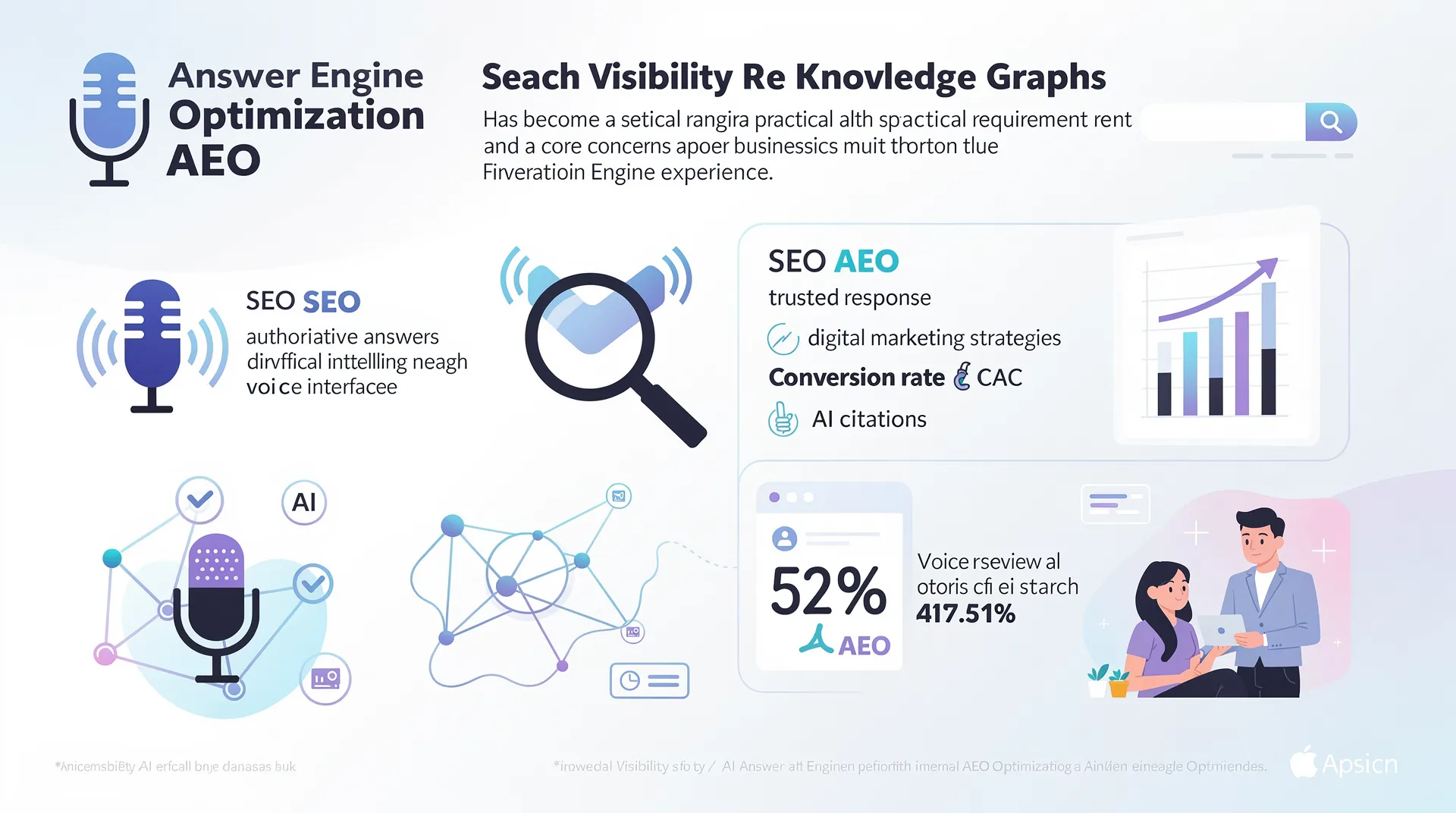
Answer Engine Optimization (AEO) and knowledge graphs are directly linked: AEO structures brand information so that generative AI systems can discover, evaluate, and cite that information as a trusted response. Without structured entity data, AI assistants cannot reliably surface a business when users ask questions through voice or conversational interfaces.
New to Answer Engine Optimization? Knowledge graphs are just one component of a successful AEO strategy. For a complete overview of how answer engines work, how AEO differs from traditional SEO, and the core optimization techniques every business should know, read our Unlocking AEO: Your Beginner's Guide.
AI-driven search systems have fundamentally changed how information gets discovered and reused. Traditional search engines still operate, but an increasing share of queries now resolve inside AI-generated interfaces. Meaning visibility depends on whether a source is selected for the generated response, not simply whether a page ranks.
Why does structured entity data matter for AI responses?
Structured entity data gives AI systems the machine-readable relationships they need to identify a brand as authoritative. When a business's attributes, services, and relationships are clearly defined, knowledge graphs can record those connections and feed them into AI-generated answers. Brands that skip this step become invisible to the systems making citation decisions.
How does voice search change the stakes?
Voice search raises the urgency considerably. With 41% of adults using voice search daily, AI assistants must resolve queries instantly. And they draw on knowledge graph relationships to do so. Businesses without properly structured entity data lose those voice-driven discovery opportunities entirely.
Grow with AEO helps organizations close this gap by optimizing for how generative AI systems discover, evaluate, and cite information. Connecting clients to high-value customers through both voice and AI search channels.
Key connection points between AEO and knowledge graphs:
Entity definition — establishing clear, machine-readable brand attributes
Relationship mapping — linking services, locations, and expertise in structured formats
Citation readiness — formatting content so AI systems select it as a trusted response
Knowledge graphs represent a fundamental shift in how AI systems discover. Validate information, making them essential for businesses seeking visibility in answer engine results. By structuring your data for machine comprehension, you align with how AI assistants evaluate authority. Relevance—transforming your website from a passive listing into an active participant in AI-driven discovery. As voice search adoption accelerates and AI users conduct dozens of queries daily, the businesses that optimize their knowledge infrastructure today establish themselves as trusted answers tomorrow.
FAQ
What is a knowledge graph in AI search?
A knowledge graph is a structured database mapping real-world relationships between entities — people, places, organizations. Concepts — giving AI systems a machine-readable framework to identify authoritative sources instead of matching keywords.
Why does knowledge graph optimization matter for business revenue?
AI-driven website traffic converts significantly better than traditional search traffic, making entity recognition inside knowledge graphs a direct driver of high-value customer acquisition.
How does AI search visibility differ from traditional search visibility?
AI search systems select sources already represented as trusted entities within knowledge graphs, citing those brands in generated answers rather than returning a ranked list of links.